Leadership isn’t just about making decisions, delegating tasks, or hitting targets.
It’s about connection. Presence. Self-awareness.
Emotional intelligence in leadership is what separates managers from true leaders—the ones who inspire trust, loyalty, and action.
Research shows leaders with high EQ have more engaged teams, stronger cultures, and better results. The best part? Emotional intelligence isn’t fixed. It’s a skill you can grow.
If you’re ready to show up more powerfully (and humanly) for your team, here are 3 simple but transformative skills to practice today.
Table of Contents
Why Emotional Intelligence in Leadership Matters
Most of us learned leadership from watching other leaders. We copied their confidence, their decisiveness, their ability to take charge. But we missed something crucial: the invisible skills that make people actually want to follow you.

Builds trust and psychological safety on teams
Trust isn’t built through grand gestures. It’s built through small, consistent actions that show you care about your team as people, not just productivity machines. When you acknowledge someone’s frustration instead of dismissing it, when you admit your own mistakes, when you check in on how someone’s doing after a tough meeting, you’re creating psychological safety.
I remember working with a leader who couldn’t figure out why her team never shared problems early. She was smart and capable. But her reactions to issues were sharp and defensive.
People shut down.
When she learned to manage her own reactions, her team started talking openly.Trust doesn’t come from telling people you’re trustworthy.
It comes from showing them you can hear hard things without blowing up.
Improves communication and reduces conflict
Here’s what nobody tells you about workplace conflict: it’s rarely about the actual issue. It’s about feeling misunderstood, undervalued, or unheard. When you develop emotional intelligence leadership skills, you start catching these underlying issues before they explode.
One manager I worked with stopped trying to “win” arguments and started listening to what people actually needed.
They didn’t just reduce drama. They built solutions together.
Empowers better decision-making under stress
Stress makes us stupid. When our emotions are running high, we make decisions based on fear, anger, or pressure instead of clear thinking. Emotional intelligence in leadership means recognizing when you’re in that state and taking steps to get back to center.
I used to pride myself on making quick decisions. But quick isn’t always smart. Now when I feel that familiar pressure building, I take a breath and ask myself: “What am I feeling right now, and how might that be affecting my judgment?” Sometimes the answer is to sleep on it. Sometimes it’s to get input from others. Sometimes it’s just to acknowledge that I’m stressed and factor that into my decision.
Drives real engagement and retention
People don’t leave jobs. They leave managers. I heard this saying countless times, but I didn’t really understand it until I started tracking why people left my team. The pattern was clear: people left when they felt disconnected, undervalued, or misunderstood. Not when the work was hard or the hours were long.
Core Components of Emotional Intelligence

The five components of emotional intelligence aren’t just academic concepts. They’re practical skills that you can develop and improve over time. Think of them as the building blocks of better leadership.
Self-Awareness: Recognizing Personal Emotions and Their Impact
Self-awareness is like having a weather app for your emotions. You start noticing patterns: “I always get impatient during budget meetings” or “I shut down when people challenge my ideas.” This awareness is the first step toward change.
I’ve coached leaders who swore they were “calm” while their teams described them as tense and unapproachable.
Self-awareness means noticing your emotional state before it hijacks your behavior.
Try This:
- Take three breaths before responding in meetings.
- Ask yourself: What am I feeling right now?
Self-Regulation: Managing Emotions Effectively in Leadership Situations
Self-regulation isn’t about suppressing emotions. It’s about choosing how to respond instead of just reacting. When someone challenges your decision in a meeting, do you get defensive? When a project goes sideways, do you panic? These are opportunities to practice self-regulation.
A client once told me she used to get snappy under stress.
We worked on naming her triggers and choosing responses that aligned with her values.
Try This:
- When angry, say: I need a moment to think.
- Practice pausing before replying.
Motivation: Harnessing Internal Forces to Drive Leadership Performance
Motivation in emotional intelligence isn’t about motivating others. It’s about understanding what drives you and staying connected to your deeper purpose. When you’re clear on your own motivation, you can better support others in finding theirs.
One leader I worked with reconnected with why he led in the first place.
His renewed motivation was contagious.
Try This:
- Write your leadership purpose in one sentence.
- Revisit it before tough conversations.
Empathy: Understanding and Valuing Team Members’ Perspectives
Empathy isn’t about agreeing with everyone. It’s about understanding where they’re coming from. When someone’s behavior doesn’t make sense to you, there’s usually a reason that makes perfect sense to them. Your job as a leader is to understand that reason.
One client thought empathy was weakness.
But when she started listening without jumping to solve, her team felt respected—and they stepped up.
Try This:
- Ask: What’s it like to be in their shoes?
- Reflect back what you hear: “So you’re saying you felt excluded?”
Social Skills: Building and Maintaining Strong Professional Relationships
Social skills in leadership go beyond being friendly. They’re about creating conditions where people can do their best work. This means knowing when to be direct and when to be supportive, when to push and when to step back.
Building these skills takes practice. One client realized he avoided feedback because he hated conflict.
We practiced giving honest feedback kindly.
It changed everything.
Try This:
Start feedback with: “I want you to succeed, so can I share an observation?”
Top 3 Emotional Intelligence in Leadership
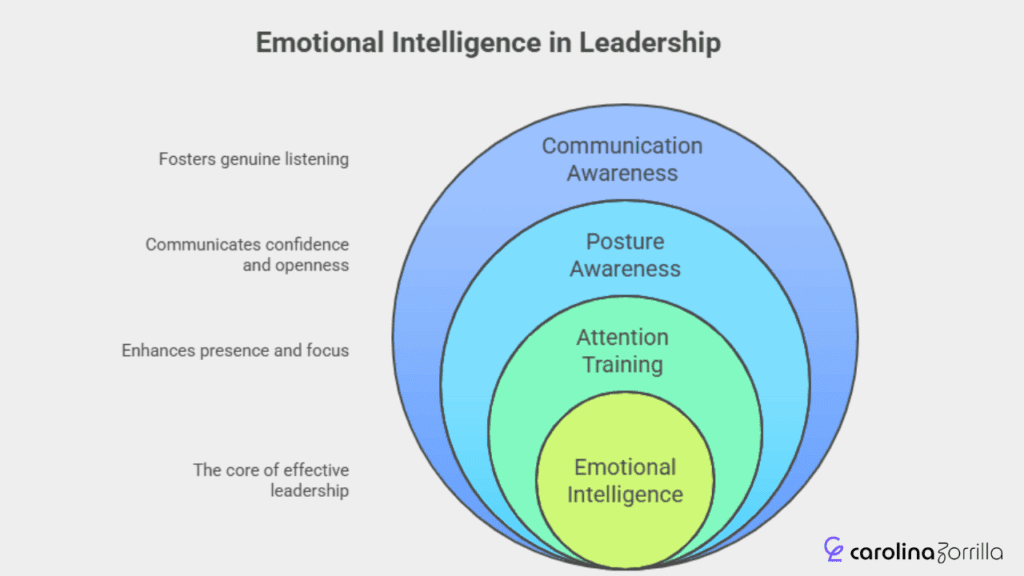
1. Listen Like You Mean It (Communication Awareness)
Real listening is rare. Most of us are waiting for our turn to talk or mentally preparing our response while the other person is speaking. But true listening is a leadership superpower.
Stop rehearsing your reply while others speak
I caught myself doing this constantly. Someone would be explaining a problem, and I’d already be formulating my solution before they finished. I thought I was being efficient, but I was actually missing important information and making people feel rushed.
Now I practice what I call “empty cup” listening. I imagine my mind as an empty cup, ready to receive whatever the person wants to share. When I notice myself starting to plan my response, I gently bring my attention back to their words.
Practice full-body listening: eye contact, nodding, reflecting
Your body language sends stronger signals than your words. When someone sees that you’re fully present, they share more openly. I learned to put away my phone, close my laptop, and turn my whole body toward the person speaking.
Reflecting back what you hear isn’t just a communication technique; it’s a way to check your understanding. “So what I’m hearing is that you’re feeling overwhelmed by the new process, and you’re worried about meeting the deadline. Is that right?” This simple practice prevents so many misunderstandings.
2. Lead with Your Body (Posture Awareness)
Your team is constantly reading your non-verbal cues. Are you approachable or intimidating? Present or distracted? Confident or anxious? Your posture communicates all of this before you say a word.
Straight, open posture signals confidence and attentiveness
Open posture isn’t about puffing out your chest or trying to look powerful. It’s about creating physical space that invites connection. Uncrossed arms, relaxed shoulders, and an open stance all signal that you’re approachable and present.
I started practicing what I call “leadership posture” throughout the day. Feet planted firmly on the ground, spine straight but not rigid, shoulders back but relaxed. It sounds simple, but it changed how I felt and how others responded to me.
Mind-body connection: your team reads your non-verbal cues
Your team is constantly scanning your body language for information about your mood, your confidence, your availability. They’re asking: “Is it safe to approach? Are you overwhelmed? Are you angry?” Your posture answers these questions before you do.
When I’m having a tough day, I make a conscious effort to maintain open, approachable body language. It’s not about pretending everything is fine; it’s about not making my team responsible for managing my emotional state.
I do a quick body scan before important meetings or conversations. “Are my feet grounded? Is my chest open? Are my shoulders relaxed?” It takes ten seconds and makes a huge difference in how the interaction goes.
3. Come Back to the Moment (Attention Training)
Leadership is incredibly distracting. Your mind is constantly jumping between past problems and future worries. But your team deserves your full attention, especially during important conversations.
Leaders juggle a million thoughts, but your team deserves your presence
I used to think multitasking was a leadership strength. I’d be in one-on-ones while mentally planning my next meeting, checking email, and worrying about upcoming deadlines. I thought I was being efficient, but I was actually being disrespectful.
When you’re physically present but mentally elsewhere, people can tell. They start keeping conversations surface-level because they know you’re not really listening. You miss important cues, and people feel undervalued.
Notice when your mind wanders (future worries, past regrets)
Mind wandering is normal, but awareness of it is crucial. I started noticing patterns in my mental distractions. During performance reviews, I’d worry about how the conversation would go. During team meetings, I’d rehash problems from earlier in the day.
Once you notice these patterns, you can catch yourself sooner. “Oh, I’m doing that thing where I’m planning my weekend during a work conversation” or “I’m stuck on what happened this morning instead of focusing on this person.”
Use breath, grounding, or mindful pauses to reset
When you notice your mind wandering, you need quick techniques to come back to the present. Deep breathing is the simplest: three slow breaths can shift your entire state. Grounding means feeling your feet on the floor and your body in the chair. Mindful pauses are moments of intentional silence where you reset your attention.
I keep a small stone in my pocket as a reminder. When I feel it during conversations, it cues me to check: “Am I fully present right now?”
Strategies to Develop Emotional Intelligence for Leadership
Developing emotional intelligence isn’t a one-time workshop or training program. It’s an ongoing practice that requires attention, intention, and patience with yourself as you learn.
Practical Exercises for Enhancing Self-Awareness
Self-awareness starts with paying attention to your internal experience throughout the day. I began keeping what I called an “emotion log” for a week. Every few hours, I’d write down what I was feeling and what triggered it.
The patterns were revealing. I got impatient during budget discussions, anxious before difficult conversations, and frustrated when people didn’t understand my ideas immediately. Recognizing these patterns was the first step toward managing them.
Another exercise that helped was asking for feedback about my emotional impact on others. I asked trusted colleagues: “How do I come across when I’m stressed? What do you notice about my communication style during difficult conversations?” Their answers were sometimes surprising but always helpful.
Techniques for Better Self-Regulation
Self-regulation is about creating space between stimulus and response. When someone challenges your decision, instead of immediately defending it, you pause and consider your options. When a project goes wrong, instead of panicking, you take a breath and assess the situation.
I developed a simple technique I call “name it to tame it.” When I feel a strong emotion rising, I literally name it: “I’m feeling frustrated right now” or “I notice I’m getting anxious.” This simple act of naming the emotion reduces its power over me.
Another technique is the “24-hour rule” for emotional reactions. If I’m angry about something, I wait 24 hours before responding. This gives me time to process the emotion and choose a more thoughtful response.
PSYCH-K® to Build EQ Faster

While traditional approaches to increasing emotional intelligence focus on conscious effort and practice, there are tools that can accelerate the process by working with subconscious beliefs and patterns.
PSYCH-K® is a process that helps identify and change subconscious beliefs that might be limiting your emotional intelligence development. Many leadership challenges stem from subconscious beliefs like “I have to be perfect” or “Showing emotion is weakness” or “I can’t trust others to handle important tasks.”
I found that addressing these underlying beliefs made all the conscious practices more effective. Instead of fighting against my natural tendencies, I was able to shift the underlying patterns that created those tendencies in the first place.
Practicing Empathy in Various Leadership Contexts
Empathy isn’t just about being nice. It’s about understanding different perspectives so you can make better decisions and build stronger relationships. I started practicing what I call “perspective-taking” in different situations.
During conflicts, I’d ask myself: “What might be driving this person’s behavior? What are they worried about? What do they need to feel successful?” This shift from judgment to curiosity changed how I approached difficult conversations.
In team meetings, I’d pay attention to who wasn’t speaking and why. Were they disengaged, or did they need more time to process? Were they holding back because they disagreed, or because they felt their perspective wouldn’t be valued?
Developing Essential Social Skills for Successful Leadership
Social skills in leadership are about creating conditions where people can do their best work. This means adapting your communication style to different people and situations, building relationships across different levels and departments, and knowing how to influence without authority.
I learned that different people need different types of support. Some team members needed detailed instructions and frequent check-ins. Others needed general direction and space to figure things out. Some wanted public recognition, others preferred private feedback.
Building relationships across the organization required stepping outside my comfort zone. I started having coffee with people from other departments, not because I needed anything from them, but because I wanted to understand their challenges and perspectives.
FAQs: Emotional Intelligence in Leadership
Is Emotional Intelligence More Important Than Technical Expertise in Modern Leadership?
This isn’t an either-or question. You need both technical competence and emotional intelligence to be an effective leader. But here’s what I’ve observed: technical skills might get you into leadership roles, but emotional intelligence determines whether you’ll be successful in them.
I’ve seen brilliant technical people struggle as leaders because they couldn’t connect with their teams or manage their own stress. I’ve also seen people with strong emotional intelligence but weak technical skills lose credibility because they couldn’t contribute meaningfully to problem-solving.
The sweet spot is having enough technical expertise to understand the work and make good decisions, combined with the emotional intelligence to lead people effectively. As you move up in leadership, the balance shifts more toward emotional intelligence because you’re increasingly working through others rather than doing the technical work yourself.
Is there room for emotions in leadership?
Absolutely. The old model of leadership assumed you should check your emotions at the door, but that’s neither possible nor effective. Emotions contain important information about what’s working and what isn’t.
The key is being intentional about how you express emotions. Anger can signal that boundaries have been crossed or values have been violated. Excitement can energize a team around a new opportunity. Concern can help you identify risks early.
How does emotional intelligence relate to social skills?
Social skills are one of the five components of emotional intelligence, but they’re built on the foundation of the other four. You can’t have good social skills without self-awareness, self-regulation, motivation, and empathy.
Think of it this way: self-awareness helps you understand your communication style and its impact on others. Self-regulation helps you choose your responses rather than just reacting. Motivation helps you stay focused on building relationships rather than just getting your way. Empathy helps you understand what others need from you.
Social skills are how you bring all of these together in your interactions with others. They’re the visible expression of your emotional intelligence in action.
The most important thing to remember is that emotional intelligence in leadership isn’t about being perfect. It’s about being intentional, aware, and committed to continuous growth. Every interaction is an opportunity to practice these skills and become a more effective leader.
About Executive Coach & Author
Hola, I’m Carolina Zorilla, an Executive & Leadership Coach helping high-achievers break free from burnout and build fulfilling careers. After 12 years in corporate, I realized chasing promotions wasn’t enough. Now, I coach professionals to redefine success, set boundaries, and find balance.
That’s why I made it my mission to help high-achieving professionals break free from burnout and build careers that fuel both ambition and well-being. Through coaching, I’ve helped leaders and entrepreneurs find balance, confidence, and fulfillment—without sacrificing growth.
If you’re ready to create a career that supports your life (not the other way around), let’s talk. Book a discovery session here.

Moving Forward
If you’re leading people, you’re dealing with emotions.
Yours and theirs.
Emotional intelligence in leadership isn’t optional.
It’s the work.
If you’re ready to get serious about it, consider a Clarity Session to talk through where you’re stuck.
Or try PSYCH-K® to shift what’s holding you back inside.
Lead with your whole self. Your team will thank you.