I stared at my computer screen for what felt like hours, cursor blinking mockingly at me. The decision seemed simple enough on paper: accept the job offer or stay put. I’d made my pros and cons list, talked to friends, even consulted my mom. But there I was, paralyzed by what should have been a straightforward choice but why can’t I make decisions.
Sound familiar?
You’ve gathered all the information. Asked everyone for advice. Made the spreadsheet. Twice. And yet, you’re still stuck, spinning in circles, second-guessing every option.
After working with hundreds of people who struggle with big life decisions, I’ve discovered that indecision isn’t about lacking information or analytical skills. It’s about identity, trust, and safety. It’s about the stories we tell ourselves and the fears we carry.
Today, I want to share five deeper, more human reasons you might feel stuck in analysis paralysis. More importantly, I’ll show you how to move forward with compassion and clarity.
Table of Contents
What Causes the Inability to Make Decisions?
Before we dive into the hidden blocks, let’s talk about what indecisiveness actually looks like. I used to think indecisive people were just wishy-washy or couldn’t handle pressure. Boy, was I wrong.
Defining Indecisiveness: Key Characteristics and Traits
Indecisiveness isn’t just changing your mind occasionally. It’s a pattern that shows up in specific ways. You might recognize yourself in some of these behaviors:
You research endlessly but never feel like you have enough information. You ask the same questions to different people, hoping someone will give you the “right” answer. You make a choice, then immediately start second-guessing it. You procrastinate on decisions by focusing on less important tasks instead.
I remember working with a marketing manager who spent six months researching master’s programs. She had spreadsheets comparing costs, rankings, and job prospects. She’d narrowed it down to three schools, then five, then back to two. The application deadlines came and went. She missed the entire enrollment cycle because she couldn’t pull the trigger.
The thing is, she wasn’t lacking information. She was protecting herself from something deeper. Which brings us to our first hidden block.
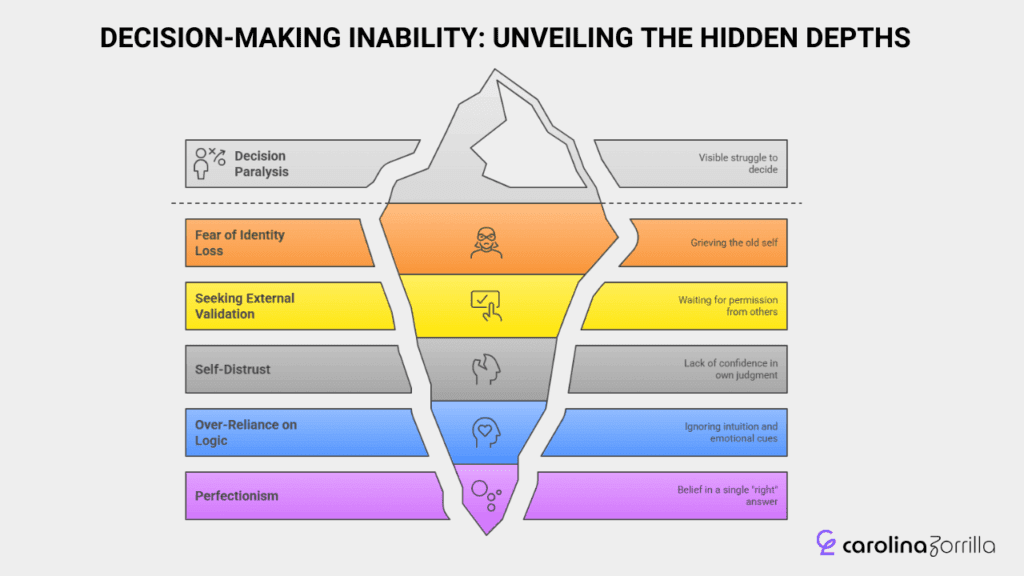
1. You’re Afraid of Losing a Version of Yourself
Big choices often mean letting go of old identities. That sounds dramatic, but think about it. When you’re considering a career change, you’re not just switching jobs. You’re saying goodbye to the version of yourself who worked in that field. When you’re thinking about moving to a new city, you’re leaving behind the you who belonged to that place.
This hit me hard when I was considering leaving my corporate job to start my own practice. On paper, it made sense. I had the skills, the passion, and enough savings to make it work. But every time I tried to make the decision, I felt this weird grief.
I was mourning the professional identity I’d built over years. The version of myself who had climbed the corporate ladder, who had a fancy title and corner office. Choosing entrepreneurship meant letting that version of me die. No wonder I kept postponing the decision.
Coaching questions:
- What version of myself do I have to leave behind if I say yes to this?
- What do I want to carry forward into my next chapter?
Practical step:
Write two lists:
- What I’m afraid of losing.
- What I’m excited to gain.
Seeing both can help you grieve and get clear about what you want.
2. You’re Waiting for Permission
This one is sneaky because it often disguises itself as “being considerate” or “getting input.” But there’s a difference between seeking advice and waiting for someone else to give you permission to want what you want.
I learned this lesson the hard way when I was considering a cross-country move. I’d found the perfect job opportunity, the salary was great, and I was excited about the adventure. But instead of making the decision, I found myself calling family members, asking what they thought.
Deep down, I was waiting for someone to say, “Yes, you can want this.” The move went against family expectations. It meant leaving behind the life everyone expected me to have. I was looking for validation that it was okay to choose my own path.
Fear of Disappointing Others Creates Paralysis
When your decisions conflict with what others expect, it creates internal tension. You know what you want, but you’re afraid of judgment, disappointment, or conflict. So you stay stuck, hoping someone will give you permission to choose differently.
This shows up constantly in my work. The woman who wants to stay home with her kids but fears disappointing her feminist mother. The man who wants to change careers but worries about his father’s reaction. The couple who wants to move abroad but can’t handle family disapproval.
The truth is, you don’t need permission to want what you want. Your desires are valid, even if others don’t understand them. The people who love you will ultimately support your happiness, even if they need time to adjust.
We’re social creatures. Belonging feels safer than authenticity.
Coaching questions:
- Whose permission am I waiting for?
- If no one had an opinion, what would I choose?
- What would change if I believed my approval was enough?
Practical step:
Write a letter to the person (real or imagined) whose approval you’re craving.
Say what you need to say.
Then write a second letter from you to you.
Giving yourself permission.

3. You Don’t Trust Yourself Anymore
This block usually develops after you’ve made a decision that didn’t work out the way you hoped. Maybe you trusted your gut once and got burned. Maybe you followed your heart and ended up hurt. Now every decision feels like a test you’re scared to fail again.
A client once told me: “Every time I’ve chosen for myself, I’ve messed it up.” She let her partner, her friends, her family decide everything. But their choices didn’t fit her. She wasn’t safe from mistakes. She was just living someone else’s life.
Past pain makes your brain hyper-cautious. It thinks inaction = safety.
Coaching questions:
- When have I made good choices in my life?
- What did I learn from the choices that didn’t work out?
- What would I choose if I trusted myself?
Practical step:
Start a “Good Decisions” journal.
List even small choices that worked out.
Prove to yourself you’re capable of choosing.
4. You’re Trying to Make a Heart Decision with Only Your Head
Some decisions aren’t meant to be analyzed to death. They’re about alignment, desire, and what feels right in your body. But our culture tells us that emotions are unreliable, that we should base important choices on logic alone.
I learned this during my own career transition. I’d created elaborate spreadsheets comparing different paths. I’d researched market conditions, salary ranges, and growth potential. On paper, staying in my corporate job made perfect sense. But every time I thought about it, I felt this heavy sensation in my chest.
My body was telling me something my spreadsheet couldn’t capture. The numbers said stay, but my soul said go. No amount of analysis was going to make the logical choice feel right because it wasn’t aligned with what I actually wanted.
Overthinking as Defense Against Vulnerability
When we’re facing a decision that really matters, it’s vulnerable. There’s risk involved. Overthinking becomes a way to stay in our heads and avoid feeling the fear, excitement, or uncertainty that comes with big choices.
I see this constantly with people considering major life changes. They’ll research for months, gather endless opinions, and create detailed plans. But underneath all that analysis, they’re avoiding the simple question: “What do I actually want?”
Sometimes the answer isn’t in your head. It’s in your body, your intuition, your sense of what feels aligned. Learning to trust those signals is a skill that takes practice, but it’s often more reliable than any amount of logical analysis.
5. You Think There’s a ‘Right’ Answer
This might be the biggest block of all. We’ve been conditioned to believe that for every decision, there’s one correct choice waiting to be discovered. If we just gather enough information, consult enough people, and think hard enough, we’ll find the perfect answer.
But most big life decisions don’t work that way. They’re not math problems with single solutions. They’re complex, nuanced choices that involve trade-offs, uncertainty, and multiple valid paths forward.
I used to torture myself trying to find the “perfect” decision. I’d analyze every angle, consider every possibility, and still feel unsure. The breakthrough came when I realized that the goal isn’t to find the right answer. It’s to make a good decision with available information and then commit to making it work.
The pressure to get it perfect keeps you stuck when what you need is to choose, commit, and adjust as you go. Most decisions can be modified or reversed if needed. The cost of staying stuck is often higher than the cost of choosing imperfectly.
I’ve started approaching decisions differently now.
Coaching questions:
- What am I afraid will happen if I choose “wrong”?
- Can I handle discomfort or regret if it comes?
- What if there isn’t a perfect choice?
Practical step:
Ask:
Is this choice good enough for now?
Can I make it work if challenges come up?
That’s real decision-making.
Rebuilding Safety and Trust Within Yourself
Healing workplace isolation requires creating internal safety, the feeling that you can trust yourself to handle whatever comes up. When you’re constantly second-guessing your instincts or overriding your needs, you create internal chaos that makes external connection difficult.
This might mean learning to notice and honor your body’s signals about when you need rest, what environments feel supportive, or which people drain your energy. It might mean practicing saying no to requests that don’t align with your values or capacity.
Building internal trust takes time, especially if you’ve been disconnected from yourself for years. But every small act of self-honoring builds your confidence that you can navigate life from your own center rather than constantly looking outside yourself for validation.
The Consequences of Indecisiveness in Daily Life
While we’ve been talking about these blocks in the context of big decisions, they affect every area of life. Indecisiveness doesn’t just impact major choices; it seeps into daily interactions and shapes how you move through the world.

Personal Life Implications
In relationships, indecisiveness can create frustration and distance. Partners may feel like they’re constantly having to make choices for both of you. Friends might stop including you in plans because you can never commit to anything.
Struggles with Personal Relationships
I’ve watched indecisiveness strain marriages, friendships, and family relationships. When you can’t make decisions, others either make them for you or get tired of waiting. Neither outcome builds healthy, balanced relationships.
Sarah, the marketing manager I mentioned earlier, told me that her indecisiveness was affecting her marriage. Her husband felt like he was making all the household decisions, from where to go on vacation to what to have for dinner. The imbalance was creating resentment on both sides.
Missed Opportunities for Growth and Exploration
Perhaps most sadly, chronic indecisiveness leads to missed opportunities. While you’re stuck analyzing, life keeps moving. Job openings get filled. Relationships develop with other people. Experiences become unavailable.
The cost isn’t just what you choose; it’s what you don’t choose. Every moment spent in indecision is a moment not spent living the life you want.
Professional Challenges
In the workplace, indecisiveness can significantly impact your career trajectory and professional reputation. Employers value people who can make decisions efficiently and stand behind them.
Impact on Career Advancement and Confidence
Managers who can’t make decisions quickly lose credibility with their teams. Projects stall while you gather more information or seek additional input. Your reputation becomes one of someone who needs constant guidance or approval.
I’ve coached executives who were passed over for promotions because they couldn’t make decisions independently. Their technical skills were excellent, but their inability to choose confidently made them unsuitable for leadership roles.
Hindrance to Innovation and Risk-Taking
Innovation requires making decisions with incomplete information. If you’re paralyzed by uncertainty, you’ll never take the risks necessary for breakthrough success. You’ll play it safe, which often means playing it small.
Emotional and Mental Health Effects
The emotional toll of chronic indecisiveness is significant. It creates a cycle of anxiety, self-doubt, and frustration that can seriously impact mental health.
Links Between Depression, Anxiety, and Indecision
Research shows strong connections between indecisiveness and both depression and anxiety. When you can’t make decisions, you feel powerless and out of control. This sense of helplessness can contribute to depressive symptoms.
Anxiety often makes indecisiveness worse. The fear of making the “wrong” choice creates more anxiety, which makes it harder to think clearly, which makes decisions feel more overwhelming. It’s a vicious cycle.
Self-Doubt and Eroded Self-Esteem
Each time you avoid making a decision, you’re essentially telling yourself that you can’t be trusted to choose well. This erodes self-confidence and creates a pattern of self-abandonment.
You start believing that others are better equipped to make decisions for your life than you are. This belief becomes self-fulfilling as you rely more on external validation and less on your own judgment.
Effective Strategies to Overcome Indecisiveness
Now that we understand the deeper blocks, let’s talk about practical strategies for moving forward. These aren’t just surface-level tips; they’re designed to address the root causes we’ve discussed.
Practical Steps to Enhance Decision-Making Skills
The goal isn’t to become someone who makes decisions quickly without thinking. It’s to develop the ability to make good decisions efficiently and then commit to them fully.
Establishing Clear Criteria and Priorities
Before you start analyzing options, get clear on what matters most to you. What are your non-negotiables? What values need to be honored? What outcomes are you hoping for?
I create what I call a “decision filter” for major choices. It’s a simple list of my top five priorities for that particular decision. Any option that doesn’t meet these criteria gets eliminated immediately. This prevents me from getting lost in endless analysis of unsuitable options.
Managing Information Intake and Simplifying Options
Information overload is a major contributor to decision paralysis. At some point, more information stops being helpful and starts being overwhelming. Learn to recognize when you have enough information to make a good decision.
I use a simple rule: if I’ve researched for more than two weeks on a decision, it’s time to choose. More information rarely changes the fundamentals of a choice; it just creates more opportunities for overthinking.
The Five-Minute Rule and Setting Deadlines
For smaller decisions, I use the five-minute rule. If a choice doesn’t significantly impact my life or can be easily reversed, I give myself five minutes to decide. This prevents minor decisions from consuming mental energy better spent elsewhere.
For bigger decisions, I set artificial deadlines. I’ll give myself two weeks to research a major purchase or one month to consider a job change. When the deadline arrives, I choose based on available information. This prevents decisions from dragging on indefinitely.
Leveraging Support Systems and Professional Help
You don’t have to make decisions in isolation. The key is finding the right kind of support for your specific blocks.
Identifying a Trustworthy Sounding Board
Find someone who can listen without trying to make the decision for you. This person should ask good questions, help you process your thoughts, and support whatever choice you make. They shouldn’t have a vested interest in your decision.
I have a small group of trusted friends who serve this role for me. They know how to help me think through options without pushing their own agenda. This kind of support is invaluable for processing complex decisions.
The Role of Therapy and Counseling
If your indecisiveness stems from deeper issues like past trauma, anxiety, or self-esteem problems, professional help can be transformative. A good therapist can help you understand the root causes of your decision paralysis and develop healthier patterns.
I’ve seen people make dramatic progress in their decision-making abilities after addressing underlying mental health issues. Sometimes the inability to choose is a symptom of something deeper that needs attention.
Celebrating Small Wins and Learning from Outcomes
Start building decision-making confidence with smaller, lower-stakes choices. Notice when you make good decisions and acknowledge them. This creates positive associations with decision-making instead of only focusing on times when things didn’t go as planned.
When decisions don’t turn out as expected, focus on what you learned rather than what went wrong. Every choice teaches you something about yourself and refines your decision-making skills for the future.
FAQs: Can’t Make Decisions
Why do I freeze when I need to make a choice?
Because your subconscious is trying to keep you safe from failure, loss, judgment, or change. It’s not about logic; it’s about protection. Your brain would rather keep you stuck than risk something going wrong.
Is overthinking always bad?
Not inherently. Thinking through important decisions is smart. But when analysis becomes a way to avoid action, it signals that fear or limiting beliefs need to be addressed. The goal is thoughtful consideration, not endless rumination.
Can these mental blocks really be changed?
Yes, absolutely. Awareness is the first step. Once you understand what’s really keeping you stuck, you can address those deeper issues. Many people see significant improvement in their decision-making abilities after working on these underlying blocks.
About Executive Coach & Author
Hola, I’m Carolina Zorilla, an Executive & Leadership Coach helping high-achievers break free from burnout and build fulfilling careers. After 12 years in corporate, I realized chasing promotions wasn’t enough. Now, I coach professionals to redefine success, set boundaries, and find balance.
That’s why I made it my mission to help high-achieving professionals break free from burnout and build careers that fuel both ambition and well-being. Through coaching, I’ve helped leaders and entrepreneurs find balance, confidence, and fulfillment—without sacrificing growth.
If you’re ready to create a career that supports your life (not the other way around), let’s talk. Book a discovery session here.

Moving Forward: Making Confident Decisions
The path forward isn’t about becoming someone who never struggles with decisions. It’s about developing the skills, awareness, and self-trust to move through choices with greater ease and confidence.
Start by recognizing which of these blocks resonates most with you. Are you afraid of losing yourself? Waiting for permission? Struggling with self-trust? Trying to logic your way through heart decisions? Searching for the perfect choice?
Once you identify your primary pattern, you can begin addressing it specifically. This might involve therapy, mindset work, or simply practicing making decisions in lower-stakes situations.
Remember, the goal isn’t to eliminate all uncertainty from decision-making. It’s to become comfortable with uncertainty while still moving forward. Life is inherently uncertain, and the ability to choose despite incomplete information is a valuable skill.
If you’re ready to work on this, consider a Clarity Session.
Or try PSYCH-K® to change the beliefs that keep you stuck.
Your life deserves your choice.
One decision at a time.