You’re productive. You’re reliable. You’re respected.
But you’re also falling apart.
This is high-functioning burnout. You hit deadlines, take care of everything, and smile on cue. But your chest tightens before every meeting. You crash on weekends. You wake up tired and wired.
No one sees it. Because you don’t let them.
I’ve been there. I remember the Sunday scaries that started on Friday afternoon. The way my jaw would clench during Zoom calls while I nodded and agreed to take on more. The exhaustion that sleep couldn’t fix because my mind never stopped racing.
Let’s talk about why this happens, how to spot it, and what you can do about it. Because recognizing high-functioning burnout is the first step to breaking free from it.
Table of Contents
What Is High-Functioning Burnout?
High-functioning burnout is burnout in disguise. It’s the kind that wears a blazer and carries a color-coded planner. You’re still showing up, still delivering, still being the person everyone counts on. But inside? You’re running on empty.
I used to think burnout meant lying in bed unable to move. That’s what I’d seen in movies, right? The dramatic collapse, the inability to function. So when I was still crushing my to-do lists while feeling completely hollow inside, I figured I was just tired. Maybe stressed. Definitely not burned out.
That’s the tricky thing about high-functioning burnout. It thrives in the gap between appearance and reality. You look successful from the outside, so you dismiss your own suffering. You tell yourself you’re fine because you’re still capable of performing.

Why It Affects High Performers Most
I worked with a client who ran a seven-figure business while homeschooling three kids. She came to me because she couldn’t understand why reaching her revenue goals felt meaningless. She’d hit every milestone she’d set, but instead of celebrating, she immediately moved the goalposts. Sound familiar?
Entrepreneurs and leaders are especially vulnerable because we’ve been conditioned to believe that struggle equals strength. That pushing through is noble. That rest is earned, not needed. We wear our busy schedules like badges of honor.
5 Signs You’re Experiencing High-Functioning Burnout
The signs of high-functioning burnout are sneaky. They masquerade as personality traits or temporary stress. Let me share what I’ve learned to watch for, both in my own experience and in working with hundreds of high-achieving women.
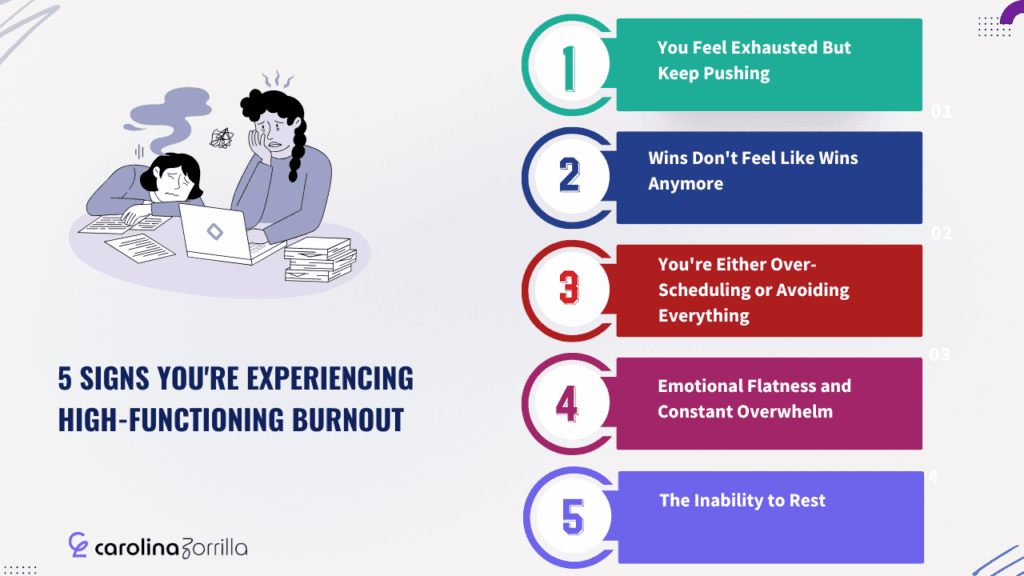
1- You Feel Exhausted But Keep Pushing
This isn’t the good tired you get after a productive day. This is bone-deep exhaustion that doesn’t improve with sleep. You wake up tired. You feel tired after your morning coffee. You’re tired even when you’re doing things you used to enjoy.
But here’s the kicker – you keep going anyway. You’ve trained yourself to override your body’s signals. You’ve gotten so good at pushing through that you don’t even notice you’re doing it anymore.
I remember drinking my third cup of coffee by 10 AM and thinking this was normal. I told myself I was just a high-energy person who needed fuel to keep up with my ambitious goals. It took months to realize that wasn’t energy – it was adrenaline keeping me upright.
2- Wins Don’t Feel Like Wins Anymore
Remember when achievements used to feel good? When you’d get excited about hitting a goal or receiving recognition? High-functioning burnout steals that from you. Success becomes just another item to check off your list.
You might get promoted, land a big client, or receive praise, and feel… nothing. Or worse, you immediately start thinking about what’s next instead of savoring the moment. The celebration lasts about five minutes before you’re already focused on the next mountain to climb.
One of my clients described it perfectly: “I feel like I’m collecting trophies for a game I don’t want to play anymore.” That hit me right in the chest because I’d been there too.
3- You’re Either Over-Scheduling or Avoiding Everything
High-functioning burnout shows up in two opposite ways, sometimes even alternating in the same person. You either pack your calendar so full there’s no time to think, or you start avoiding commitments altogether because everything feels overwhelming.
The over-scheduling is often an attempt to outrun the burnout. If you’re busy enough, you don’t have to sit with the uncomfortable feelings. You don’t have to face the fact that something is wrong.
The avoidance happens when the system starts breaking down. Suddenly, responding to emails feels impossible. Making decisions becomes paralyzing. You procrastinate on things that used to be automatic.
4- Emotional Flatness and Constant Overwhelm
This might be the most confusing symptom. You’re not sad exactly, but you’re not happy either. You’re just… flat. Colors seem muted. Things that used to bring you joy feel like work. You go through the motions but don’t feel present for your own life.
At the same time, everything feels like too much. Small decisions become major ordeals. Your tolerance for noise, interruptions, or unexpected changes drops to zero. You snap at people you care about over minor things.
I spent months feeling like I was living behind glass – I could see everything happening, but I couldn’t quite connect with it. It’s a lonely feeling, especially when everyone around you thinks you’re doing great.
5- The Inability to Rest
This is the most frustrating part. Even when you try to rest, you can’t. Your mind races. You feel guilty for not being productive. You check your phone compulsively. You make mental to-do lists during yoga class.
Rest starts to feel foreign, almost threatening. You’ve been in motion for so long that stillness feels dangerous. What if you stop and can’t start again? What if people realize you’re not as capable as they thought?
I used to plan my weekends like work projects. I’d schedule downtime and then feel anxious if I wasn’t maximizing my relaxation correctly. The irony wasn’t lost on me, but I couldn’t seem to stop.
Why Traditional Burnout Advice Doesn’t Work for You

If you’ve been googling “burnout recovery” and feeling frustrated by what you find, you’re not alone. Most burnout advice assumes you’ve hit rock bottom and can’t function. But high-functioning burnout is different. You’re still functioning – that’s the problem.
Surface-Level Self-Care Misses the Point
Take a bubble bath. Go for a walk. Practice gratitude. Get more sleep.
These suggestions aren’t wrong, but they’re like putting a band-aid on a broken bone. When your burnout is rooted in deep beliefs about your worth and value, surface-level self-care feels hollow at best and impossible at worst.
I tried all the typical advice. I bought the fancy bath salts and the meditation app subscription. I blocked time for self-care in my calendar like it was another project to manage. But I couldn’t shake the feeling that I was doing it wrong, even when I was supposedly relaxing.
The real issue isn’t that you don’t know how to take care of yourself. It’s that part of you doesn’t believe you deserve care unless you’ve earned it through productivity. Until that changes, self-care feels like another obligation instead of genuine nourishment.
The Productivity-Worth Connection
High-functioners have a particularly stubborn form of burnout because we’ve tied our identity to our output. We don’t just do things – we are what we do. Our worth feels directly connected to our productivity, our usefulness, our ability to handle whatever comes our way.
This makes traditional rest feel threatening. If you’re not producing, who are you? If you’re not solving problems, what’s your value? If you’re not busy, are you lazy?
I remember the first time someone suggested I take a real vacation – not a working vacation where I checked emails, but a genuine break. My immediate thought was, “But what if people forget about me?” That’s when I realized how deep the productivity programming ran.
The “Not Sick Enough” Trap
High-functioning burnout exists in a gray area that makes it easy to dismiss. You’re not hospitalized. You’re not having panic attacks. You’re not missing work. So surely you can’t be that bad off, right?
This is dangerous thinking. You don’t have to collapse to deserve support. You don’t have to be non-functional to need help. But because high-functioning burnout is invisible, even to healthcare providers sometimes, you might not get taken seriously.
I delayed getting help for months because I kept thinking other people had it worse. I was still showing up, still performing, still managing everything. How could I complain? This comparison game keeps you stuck longer than necessary.
Rest Triggers Guilt Instead of Relief
When you finally do try to rest, guilt crashes the party. You feel selfish for taking time off. You worry about what’s not getting done. You think about all the people who might need you while you’re unavailable.
The guilt is so intense that rest becomes more stressful than work. At least when you’re working, you feel justified. When you’re resting, you feel like you’re stealing time that belongs to someone else.
This is where understanding your relationship with rest and productivity becomes crucial. The guilt isn’t rational – it’s programmed.
The Cost of Staying in High-Functioning Burnout
Let’s be honest about what happens when you ignore high-functioning burnout. It doesn’t go away on its own. It doesn’t get better with time. It gets worse, and it takes pieces of you with it.
The Silent Erosion of Self
High-functioning burnout is a slow thief. It steals your joy so gradually you don’t notice until it’s gone. It erodes your confidence so subtly that you start questioning everything. It dampens your motivation until even your biggest dreams feel flat.
You stop trusting your instincts because you’re so disconnected from yourself. You second-guess decisions you would have made confidently before. You lose touch with what you actually want because you’ve been focused on what you should want for so long.
I watched this happen to a brilliant executive I worked with. She’d built an incredible career, but by the time she came to me, she couldn’t remember why she’d wanted any of it. She felt like she was living someone else’s life, going through motions that had lost all meaning.
Physical Health Consequences
Your body keeps the score, even when your mind tries to push through. High-functioning burnout shows up as mysterious aches and pains, frequent illnesses, digestive issues, and sleep problems that no amount of melatonin can fix.
Autoimmune conditions are particularly common among high-functioning burned-out women. Your immune system gets confused by the constant stress signals and starts attacking healthy tissue. You might develop thyroid problems, digestive disorders, or inflammatory conditions that seem to come out of nowhere.
The insomnia is especially cruel. You’re exhausted all day, but when you finally get to bed, your mind won’t stop. You lie there thinking about everything you didn’t finish, everything you need to do tomorrow, everything that could go wrong.
Relationship Fallout
High-functioning burnout makes you emotionally unavailable even when you’re physically present. You go through the motions of connection without actually connecting. You listen but don’t really hear. You’re there but not really there.
Your irritability increases, so you snap at people over small things. Your capacity for empathy decreases, so you struggle to be present for others’ problems. You might withdraw altogether because maintaining relationships feels like another job you’re failing at.
The people closest to you suffer the most because they get your leftover energy, which isn’t much. They see you giving your best to work, to clients, to everyone else, while they get the tired, cranky version of you.
Professional Impact
Ironically, the thing you’re trying to protect by pushing through – your career success – eventually suffers too. High-functioning burnout kills creativity, innovation, and strategic thinking. You become reactive instead of proactive. You focus on urgent tasks while important projects languish.
Your decision-making becomes impaired because you’re operating from a depleted state. You might make choices that seem right in the moment but don’t align with your long-term goals. You lose sight of the bigger picture because you’re stuck in survival mode.
The work that once energized you starts feeling like drudgery. You coast on past achievements instead of pushing boundaries. Your professional growth stagnates because you don’t have the mental or emotional resources to take on new challenges.
Healing Begins When You Redefine Success
Real recovery from high-functioning burnout isn’t about managing symptoms or finding better coping strategies. It’s about examining the beliefs that created the burnout in the first place. And that means getting honest about whose definition of success you’ve been chasing.

Whose Voice Is in Your Head?
Take a moment to think about your current goals. The things you’re striving for, the standards you hold yourself to, the measures of success that drive your decisions. Now ask yourself: where did these come from?
Were they consciously chosen by you, or absorbed from family, culture, or industry expectations? Are you chasing achievements that actually matter to you, or achievements that you think should matter to you?
I had a powerful moment when I realized that my definition of a successful day looked exactly like my father’s definition of a successful day. I was measuring my worth by his yardstick without ever questioning whether it fit my values or my life.
This isn’t about blaming anyone. Our families, schools, and cultures do their best to prepare us for success. But sometimes the blueprints we inherit don’t match the lives we want to build.
The Subconscious Success Programming
Most of our beliefs about success, worth, and productivity were formed before we were seven years old. That’s when our subconscious minds were most impressionable, soaking up messages about how the world works and what we need to do to be safe and loved.
Maybe you learned that good girls don’t cause trouble. That love is conditional on performance. That rest is selfish. That your value comes from being needed. These beliefs feel true because they’ve been with you so long, but they’re not universal truths – they’re programs that can be changed.
This is where traditional therapy sometimes falls short. You can understand intellectually that you don’t have to be perfect, but if your subconscious mind believes that imperfection equals danger, you’ll keep pushing yourself regardless of what your conscious mind knows.
Feeling Safe to Live on Your Terms
The deepest work often involves creating safety around authenticity. Many high-functioning burned-out women have learned to perform a version of themselves that they think is more acceptable or successful. Recovery means feeling safe to be who you actually are, not who you think you should be.
This might involve beliefs about disappointing others, being too much or not enough, or trusting your own judgment. When these old patterns shift, you often find that your career and relationships improve because you’re showing up as yourself rather than as a carefully crafted image.
The goal isn’t to become a different person – it’s to become more yourself. The driven, capable, successful part of you doesn’t disappear when you heal from burnout. It just gets to operate from a foundation of genuine self-worth instead of proving and performing.
If you’re recognizing yourself in these patterns and want to explore how subconscious reprogramming might help your specific situation, I offer a free clarity session where we can discuss your unique challenges and goals.
FAQs: High-Functioning Burnout
What causes high-functioning burnout?
High-functioning burnout typically stems from deeply ingrained beliefs around perfectionism, achievement, and being needed. These beliefs are often shaped by childhood experiences, family dynamics, or professional conditioning. The need to prove worth through productivity becomes so automatic that it continues even when it’s causing harm.
Is high-functioning burnout dangerous?
Yes, it can be very dangerous precisely because it’s invisible to most people, including yourself. It gradually erodes your physical health, mental wellbeing, and relationships while you continue to appear successful. Many serious health conditions are linked to chronic stress and the constant activation of your nervous system that comes with pushing through exhaustion.
How long does it take to recover from high-functioning burnout?
Recovery time varies greatly depending on how long you’ve been burned out, how deeply ingrained your patterns are, and what kind of support you have. Some people notice shifts immediately when they start addressing the root beliefs, while others need months of consistent work. The key is addressing the underlying beliefs that created the burnout rather than just managing symptoms.
About Executive Coach & Author
Hola, I’m Carolina Zorilla, an Executive & Leadership Coach helping high-achievers break free from burnout and build fulfilling careers. After 12 years in corporate, I realized chasing promotions wasn’t enough. Now, I coach professionals to redefine success, set boundaries, and find balance.
That’s why I made it my mission to help high-achieving professionals break free from burnout and build careers that fuel both ambition and well-being. Through coaching, I’ve helped leaders and entrepreneurs find balance, confidence, and fulfillment—without sacrificing growth.
If you’re ready to create a career that supports your life (not the other way around), let’s talk. Book a discovery session here.

You Don’t Need to Collapse to Choose Healing
Recovery is possible, and it starts with acknowledging that what you’re experiencing is real and valid, even if it’s invisible to others. You deserve to feel as good as you appear to be doing. You deserve to enjoy your success instead of just enduring it.
Whether you’re feeling stuck in your career or struggling with the pressure to do it all, remember that high-functioning burnout is not a character flaw or a sign of weakness. It’s a signal that it’s time to redefine success on your own terms.
Ready to explore what recovery might look like for you? Book a free clarity session to discuss your specific situation and learn how subconscious reprogramming can help you reclaim your energy, joy, and authentic success.