My oldest daughter just graduated from high school, and we are preparing for her to go to Spain, where she will attend college. The past year has been a roller coaster of emotions, just imagining what it would feel like to have her so far away from home.
“You’ll be fine.” That’s what I kept telling myself. I focus on the positive and remind myself that she is following her dreams. However, as a mother, I sometimes find myself grieving the act of letting her go.
Life transitions don’t always crash in like a wave. Sometimes, they tiptoe in quietly, with an empty bedroom and leftovers that no one touches. Whether it’s an empty nest, a career pivot, or a quiet unraveling of a relationship, big life shifts stir something deep inside.
According to the American Psychological Association, major life events are one of the top stressors affecting women’s health and long-term satisfaction. I get it now.
But here’s what I learned in the middle of this life change: I thought I was prepared. I had my coaching practice. My routine. My independence. But as soon as she left, the silence felt loud.
Let me walk you through what I learned, not as a coach, but as a woman figuring it out one day at a time.
Table of Contents
What Is a Life Transition? Why It Hits So Hard
Life transitions aren’t always dramatic. But they are always personal.
A life transition might be a kid leaving home, a career change, a divorce, death of a loved one, or even a quiet awakening that you don’t want to live the way you used to. It’s less about what’s happening around you and more about the identity shift happening inside you.
These changes mess with our identity in ways we don’t always see coming.
I remember coaching a client who felt completely lost after her promotion to director. On paper, everything looked great. But she kept saying, “I don’t know who I am in this role.” That’s identity disruption at work. When our external circumstances change, our internal sense of self has to catch up.
For high-achieving women, this hits even harder. We’re used to managing everything, staying strong, and figuring things out. When life shifts and we feel unsteady, our first instinct is often to push through rather than pause and process.
But feeling shaky during a transition doesn’t mean you’re doing it wrong. It means you’re human.
The research backs this up too. Women report higher levels of stress during major life transitions, partly because we tend to carry more emotional labor in our relationships and families. When those dynamics shift, we feel it more deeply.
What Happens When We Lose Trust in Ourselves
The cycle is vicious and familiar. You overthink a decision until you’re paralyzed. Then you doubt your ability to choose well. Then you fear making the wrong choice so much that you avoid choosing at all.
I see this pattern constantly in my coaching practice. Smart, capable women who can make complex decisions at work become completely overwhelmed when it comes to their own lives.
The root of this is usually the same: somewhere along the way, we stopped trusting our inner voice. Maybe we made a choice that didn’t work out the way we hoped. Maybe we listened to someone else’s advice instead of our own instincts. Maybe we got so used to meeting other people’s expectations that we forgot what our own expectations even were.
When we outsource our power to make decisions, clarity disappears. You can’t think your way to knowing what’s right for you. You have to feel your way there.
The toll of ignoring your inner voice is quiet but real. You start second-guessing everything. You feel disconnected from yourself. You lose confidence in your ability to choose well, which makes every decision feel monumental.
I spent years in this cycle. Every choice felt like it could make or break my life. The pressure was suffocating, and it kept me stuck in situations that weren’t serving me because making a change felt too risky.
The turning point came when I realized I wasn’t actually bad at making decisions. I was just scared of making the wrong ones. And that fear was keeping me from making any decisions at all.
My Turning Point: The Day My Daughter Graduated from High School.

As an expat family, we have moved frequently over the past 22 years, living in several different countries. My children have never lived in one place for more than four years—they are truly citizens of the world. These life changes haven’t always been easy. They’ve brought a great deal of stress and required adaptation, resilience, and flexibility from every single member of the family. Because of all these transitions, I thought I was prepared for just another one: my daughter leaving for college.
The beauty of life transitions is that you experience each one differently. I believe they teach you exactly what you need to learn at that particular moment in your life. Throughout my daughter’s senior year, I found myself moving through emotions of grief and learning to navigate the process of letting her go.
How can I let go? What is my role now, as her mother? How will we communicate and stay close across the distance?
Many questions arose, along with emotions I’ve worked hard to process and manage.
Finally, graduation day arrived. I had imagined it would be the hardest of all, filled with a complex mix of pride, joy, and nostalgia. I even warned my daughter, my husband, and our family to prepare for the possibility that I might break down in tears.
But to my surprise, I didn’t. I was calm, proud, and deeply grateful. I did cry, but they were tears of joy. I was genuinely happy to see her reach such an important milestone.
That night, as I reflected on the day, something clicked. This wasn’t just about missing my daughter. It was about something deeper: a shift in my entire sense of self, and I had no roadmap for who I was becoming.
I wasn’t just a mom anymore. I was a woman with space to ask new questions, without clear answers yet in sight.
It was grief, yes. But it was also an invitation.An invitation to get curious.To look inward.
To redefine what this next chapter could look like, on my own terms.
It turns out, having the tools doesn’t make you immune to the process. It simply means you know what to do once you stop resisting it.
5 Strategies That Helped Me Move Through this Life Change
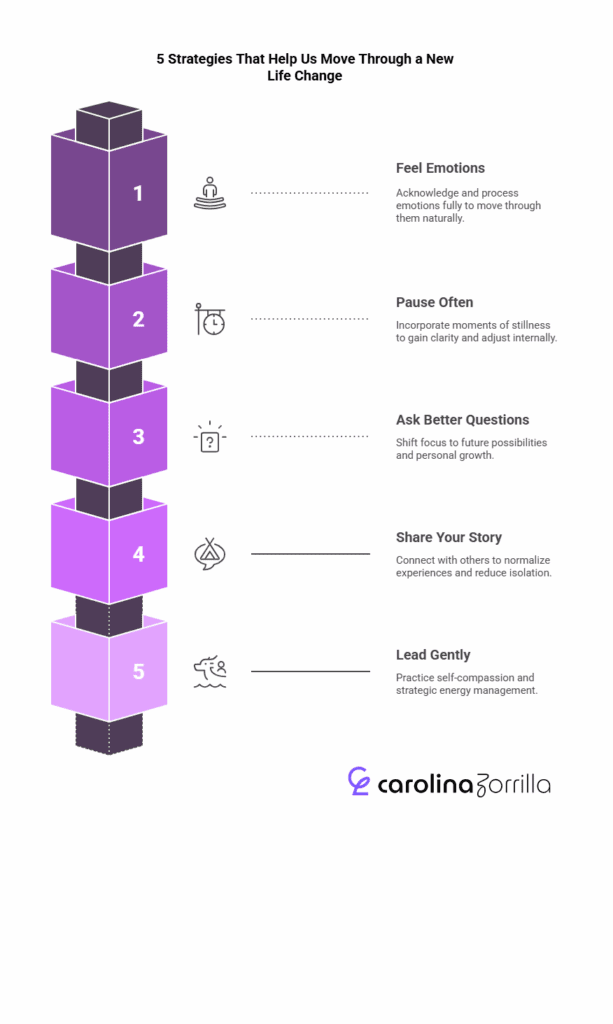
1. Feel it fully
This was the hardest one for me. My instinct was to analyze my way out of the emotions. Why was I feeling this way? What could I do to fix it? How could I get back to normal as quickly as possible?
But grief doesn’t work that way. Neither does the identity confusion that comes with major life transitions.
I started setting aside time each day to just feel whatever was coming up. Sometimes that meant crying in my car. Sometimes it meant journaling angry thoughts that I’d never want anyone to read. Sometimes it meant just sitting quietly and letting the sadness wash over me.
The research on emotional processing is clear: when we try to skip over difficult emotions, they tend to stick around longer. When we feel them fully, they move through us more naturally.
One tool that helped was what I call “emotional check-ins.” Three times a day, I’d ask myself: What am I feeling right now? Where do I feel it in my body? What does this emotion need from me?
Usually, the answer was simple: acknowledgment, compassion, or just a few minutes of quiet space.
2. Pause often
Life transitions make us want to DO something. Make a plan, take action, solve the problem. But sometimes the most powerful thing you can do is pause.
I started building small pauses into my day. Two minutes of deep breathing before I checked email. A five-minute walk around the block before making dinner. Ten minutes of sitting quietly with my coffee before the day got busy.
These weren’t meditation sessions or anything fancy. They were just moments of stillness in a season that felt chaotic.
Stillness creates clarity. When your external world is shifting, your internal world needs space to process and adjust. The pauses gave me that space.
3. Ask better questions
This question changed everything for me. Instead of asking “Why am I feeling this?” or “Why is this so hard?” I started asking “Who am I becoming?”
The first question felt like a loss. The second question felt like a possibility.
I started journaling about this regularly. What parts of myself had I put on the back burner during the intense parenting years? What dreams had I tucked away? What aspects of my personality felt ready to emerge?
The answers surprised me. I realized I’d been so focused on being the mom my daughter needed that I’d lost touch with some parts of myself I really missed. My love for trying new things. My interest in cooking. My desire to write more.
This wasn’t about replacing my identity as a parent. It was about expanding it to include other parts of who I was becoming.
4. Share your story
I’m naturally pretty private, but isolation during a life transition is a trap. I learned this the hard way.
After about a month of trying to handle everything on my own, I started reaching out. I started working on this topic with my coach. I shared my thoughts and emotions with other mom’s with sons or daughters in senior year. I had honest conversations with clients who were also navigating major life changes.
What I discovered was that sharing my story didn’t make me more vulnerable. It made me feel less alone.
Almost everyone I talked to had their own version of this experience. The details were different, but the emotions were familiar. The identity confusion, the unexpected grief, the feeling of being unmoored.
Talking about it didn’t fix anything, but it normalized everything. And that was exactly what I needed.
5. Lead yourself gently
This is probably the most important strategy, and the one I resist the most. When I’m struggling, my instinct is to be harder on myself, not gentler.
But life transitions require self-compassion, not self-criticism.
I started treating myself the way I’d treat a good friend going through the same thing. With patience, kindness, and realistic expectations.
This meant letting myself have bad days without making it mean anything about my character. It meant celebrating small wins, like making it through a difficult week without falling apart. It meant asking for help when I needed it instead of trying to power through alone.
Leading yourself gently doesn’t mean being soft or unfocused. It means being strategic about your energy and compassionate about your process.
How Life Coaching Supports Women in Transition
Most women try to logic their way through transitions. We read the books. Make the pros and cons list. Stay “productive.”
When you’re in the middle of a life transition, your brain is working overtime to process the change and figure out what comes next. Having a safe space to think out loud makes a huge difference.
In coaching, we create that space. No judgment, no pressure to have it all figured out, just room to explore what’s really going on beneath the surface.
The strategy piece is important too. Life transitions require both emotional processing and practical planning. You need to feel your feelings AND figure out your next steps. Good coaching helps you do both.
I think about my client, who came to me feeling completely burnt out in her corporate job. She knew she wanted something different but had no idea what. Through our work together, she realized her exhaustion wasn’t just about her workload. It was about being in a role that didn’t align with her values anymore.
We spent time processing the grief of leaving a career she’d worked hard to build. We also spent time visioning what she actually wanted her professional life to look like. Six months later, she launched her own consulting practice and hasn’t looked back.
The combination of emotional support and strategic thinking is what makes coaching so effective during transitions. You’re not just getting advice. You’re getting partnership in figuring out who you’re becoming and how to get there.
When to Seek Support in a Life Transition

Not every life transition requires professional support, but some do. Here are the red flags I watch for, both in my own life and with clients.
Emotional numbness that lasts more than a few weeks is a big one.
If you’re feeling disconnected from yourself, your relationships, or things you usually care about, that’s a sign you might need extra support.
Resentment that feels overwhelming or persistent is another indicator.
Some resentment is normal during transitions, but when it starts affecting your relationships or your ability to function, it’s time to get help.
Extreme fatigue that doesn’t improve with rest is also worth paying attention to.
Life transitions are exhausting, but if you’re sleeping enough and still feeling wiped out all the time, your body might be telling you something.
Change feels too big to navigate alone.
The biggest indicator for me is when the change feels too big to navigate alone. There’s no shame in admitting you need support. Some transitions are just too complex or emotionally challenging to handle solo.
Professional guidance can help you avoid emotional stagnation. When you get stuck in a transition, it’s easy to stay stuck for months or even years. A good coach or therapist can help you identify where you’re getting caught and give you tools to move forward.
You don’t have to wait for a breakdown to seek support. Sometimes, the smartest thing you can do is get help before everything falls apart.
Working with a coach gives you a space to breathe, reflect, and build a plan that feels right for you.
FAQs: How to Manage Life Transitions
What are the negative effects of transitions?
Life transitions can cause stress, anxiety, depression, and physical symptoms like headaches or sleep problems. They can also strain relationships and affect work performance. The key is recognizing these effects are temporary and normal, not signs of personal failure.
How long does it take to adjust to a major life change?
Most research suggests it takes 3-6 months to adjust to a major life change, but this varies widely based on the individual and the type of change. Some people adjust in weeks, others need a year or more. Give yourself permission to take the time you need.
What to do when you struggle with transitions?
Start with the basics: adequate sleep, regular movement, and good nutrition. Create routines that provide stability during the chaos. Reach out for support from friends, family, or professionals. Practice self-compassion and remember that struggling with change is completely normal.
About Executive Coach & Author
Hola, I’m Carolina Zorilla, an Executive & Leadership Coach helping high-achievers break free from burnout and build fulfilling careers. After 12 years in corporate, I realized chasing promotions wasn’t enough. Now, I coach professionals to redefine success, set boundaries, and find balance.
That’s why I made it my mission to help high-achieving professionals break free from burnout and build careers that fuel both ambition and well-being. Through coaching, I’ve helped leaders and entrepreneurs find balance, confidence, and fulfillment—without sacrificing growth.
If you’re ready to create a career that supports your life (not the other way around), let’s talk. Book a discovery session here.

Life Transitions Aren’t Breakdowns. They’re Breakthroughs In Disguise.
Disguise.
While they might feel lonely or destabilizing in the moment, they are also one of the most powerful invitations to reconnect to who you really are.
Whether your shift is personal or professional, quiet or dramatic, you don’t have to navigate it alone. The tools and strategies I’ve shared here have helped me and dozens of clients move through transitions with more grace and less struggle.
Change is never easy, but it doesn’t have to be overwhelming. Sometimes the most profound growth happens in the space between who we were and who we’re becoming.
If you’re in that space right now, be patient with yourself. Feel your feelings. Pause often. Ask good questions. Share your story. Lead yourself gently.
And remember: you’re not falling apart. You’re breaking open.
Ready to move through your transition with clarity and support?
Let’s talk. Book a free connection call and start your next chapter grounded in truth, purpose, and strength.