You’ve checked all the boxes, career, family, responsibilities. But now? You feel unrecognizable to yourself.
Midlife crises isn’t just a season. For many women, it’s a quiet unraveling, one that no one warned us about. You might look like you have it all together on the outside, but inside, you’re questioning everything.
This isn’t about clichés or breakdowns. It’s a wake-up call to come home to yourself. Let’s break down the real female midlife crisis stages, why they’re so emotionally intense, and how midlife crisis counseling and therapy can help you heal and rebuild, on your terms.
Table of Contents
What Is a Midlife Crisis in Women And Why It Looks Different Than Men’s
When most people think of midlife crisis, they picture a man buying a sports car or leaving his family for a younger woman. But women’s midlife crisis? It’s completely different. And honestly, it’s way more complex.
I remember sitting in my office one Tuesday afternoon, staring at my computer screen. I had everything I thought I wanted. A successful career, a family, the house with the white picket fence. But I felt like I was watching my life happen to someone else. I couldn’t shake the feeling that I was sleepwalking through my own existence.
That’s when I realized women’s midlife crises are largely internal. We don’t typically blow up our lives in dramatic fashion. Instead, we quietly suffocate under the weight of everyone else’s expectations. We become masters at emotional labor, putting everyone’s needs before our own until we can’t even remember what we actually want anymore

Cultural Pressure and Internalized Expectations
The cultural roles and pressure make women’s midlife crisis more internalized than men’s. Society tells us we should be grateful for what we have. We’re not supposed to want more or different. We’re supposed to be content with being the caretaker, the supporter, the one who holds everything together. So when we start feeling empty inside, we blame ourselves instead of recognizing it as a natural part of our growth.
What really gets me is how many women experience grief around identity loss, unmet dreams, or changing roles. You spend decades being the mother, the partner, the leader at work. But what happens when your kids grow up? When your relationship changes? When you realize you’ve been climbing the wrong ladder at work?

The Spiritual and Emotional Breakdown
Many women experience a spiritual or emotional breakdown, not just external shifts. It’s not about changing your hair or your job, though those might happen too. It’s about your soul crying out for authenticity after years of living according to someone else’s script.
I’ve worked with countless women who describe feeling like they’re living someone else’s life. One client told me, “I look in the mirror and don’t recognize the woman staring back at me.” Another said, “I achieved everything I thought I wanted, but I feel emptier than ever.”
This isn’t depression, though it can feel similar. This is your inner wisdom demanding that you pay attention to what’s been buried under years of “shoulds” and “supposed tos.”
The 5 Emotional Stages of a Female Midlife Crisis
After years of working with women going through this transition, I’ve noticed there are usually five distinct emotional stages. Not every woman experiences them in the same order, and some might skip stages or cycle back through them. But understanding these stages can help you realize you’re not going crazy, you’re going through something completely normal and necessary.
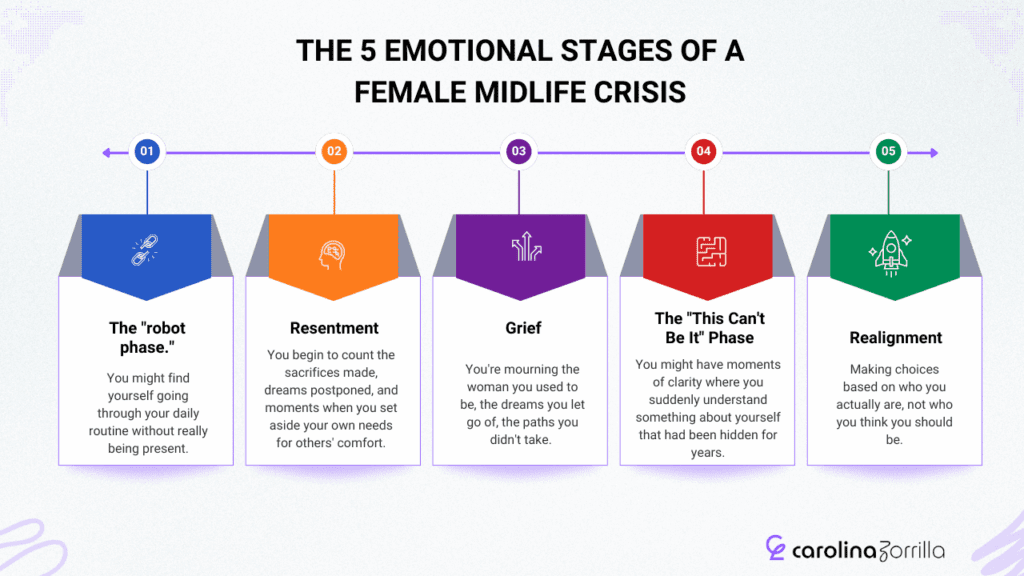
1- Disconnection: The “robot phase.”
This is where it all starts for most women. You wake up one day and realize you’ve been on autopilot for months, maybe years. You’re doing all the right things, checking all the boxes, but you feel completely disconnected from your own life.
I call this the “robot phase.” You’re functioning, but you’re not really living. You might find yourself going through your daily routine without really being present. You smile when you’re supposed to smile, laugh when you’re supposed to laugh, but inside you feel numb.
One of my clients described it as “watching my life happen through thick glass.” She was successful, had a loving family, but felt like she was observing everything from a distance. She couldn’t connect with her own emotions or desires. Everything felt flat and colorless.
This disconnection often starts gradually. Maybe you notice you’re not as excited about things that used to bring you joy. Or you realize you can’t remember the last time you did something just because you wanted to. You might catch yourself wondering, “Is this really it? Is this all there is?”
The scary part about this stage is how easy it is to stay here. Society rewards women for being selfless and putting everyone else first. So when you’re disconnected from yourself, people might actually praise you for being so “together” and “selfless.” But inside, you’re slowly dying.
2- Resentment: Unfulfilled Dreams
Once you start waking up from the disconnection, the anger comes. And boy, can it be intense. This is the stage where you start tallying up all the sacrifices you’ve made, all the dreams you’ve put on hold, all the times you’ve swallowed your own needs to make everyone else comfortable.
The anger can feel overwhelming because it’s not just about recent events. It’s about years, sometimes decades, of accumulated resentment. You start thinking about all the times you stayed quiet when you should have spoken up. All the times you made yourself smaller to make others comfortable. All the dreams you put on the back burner that are now collecting dust.
This stage can be particularly challenging because women aren’t supposed to be angry. We’re supposed to be understanding and forgiving and gracious. So when this rage bubbles up, we often feel guilty about feeling it. But this anger is important, it’s your soul’s way of saying “enough.”
3- Grief: Mourning the Life You Thought You’d Have
This might be the hardest stage of all. Once the anger starts to settle, the grief comes in waves. You’re mourning the woman you used to be, the dreams you let go of, the paths you didn’t take. It’s like grieving the death of someone who was never fully alive in the first place, the authentic you.
The grief isn’t just about big things like career changes or relationship endings. It’s about the small daily betrayals of yourself. The times you bit your tongue when you wanted to speak up. The creative projects you never started. The adventures you never took because you were too busy taking care of everyone else.
This grief can feel endless sometimes. You might find yourself crying at random moments, feeling sad for no apparent reason, or experiencing a deep sense of loss that’s hard to explain to others. People might tell you to “count your blessings” or “be grateful for what you have,” but that just makes the grief feel more isolating.
The truth is, this grief is sacred. You’re mourning the parts of yourself that got buried under years of expectations and obligations. You’re grieving the woman you never got to be because you were too busy being who everyone else needed you to be.
4- Awakening: The “This Can’t Be It” Phase
After you’ve been through the disconnection, the anger, and the grief, something interesting starts to happen. You begin to wake up to deeper truths about yourself and your life. This is the “this can’t be it” phase where you start questioning everything and seeing possibilities you couldn’t see before.
This awakening often comes in waves. You might have moments of clarity where you suddenly understand something about yourself that had been hidden for years. Or you might start noticing patterns in your life that you never saw before. It’s like someone turned on a light in a room that had been dark for years.
This stage can be both exhilarating and terrifying. Exhilarating because you’re finally seeing possibilities and reconnecting with parts of yourself you thought were gone forever. Terrifying because awakening means you can’t go back to sleepwalking through your life. Once you see the truth, you can’t unsee it.
Some women describe this as a spiritual awakening. Others talk about it as finally coming home to themselves. Whatever you call it, it’s the moment when you realize that the life you’ve been living doesn’t have to be the life you continue living.
5- Realignment: Choosing a New Path That Aligns with Your True Self
The final stage is realignment, and this is where the real work begins. This is where you start making choices based on who you actually are, not who you think you should be. It’s where you begin creating a life that feels authentic and aligned with your values and desires.
Realignment doesn’t mean you have to blow up your entire life, though some women do make dramatic changes. For many, it’s about small, consistent choices that gradually shift your life in a more authentic direction. Maybe you start saying no to commitments that drain you. Maybe you pursue a hobby you’ve always been interested in. Maybe you have honest conversations with people in your life about what you need.
This stage requires courage because you’re often going against the expectations others have of you. People might not understand why you’re changing or what you’re seeking. They might try to pull you back into the old patterns because your growth makes them uncomfortable.
I’ve seen women in this stage make incredible transformations. Some start new businesses that align with their values. Others reclaim their drive in their midlife career after years of feeling stuck. Some completely restructure their relationships to be more authentic and fulfilling.
The beautiful thing about realignment is that it’s ongoing. It’s not a destination you reach and then you’re done. It’s a way of living where you continuously check in with yourself and make adjustments when things don’t feel right.
Hidden Triggers Women Don’t Expect

Family Dynamics and Empty Nest Syndrome
Adult children leaving or family dynamics shifting is another trigger that can blindside you. You spend years being needed, being central to your family’s daily functioning, and then suddenly you’re not. The empty nest syndrome is real, but it’s more than just missing your kids. It’s realizing that a huge part of your identity was tied up in being a mother, and now you have to figure out who you are when you’re not actively parenting.
I’ve worked with women who felt completely lost when their youngest child left for college. They’d spent so many years focused on their children’s needs and schedules that they didn’t know what to do with themselves. One client said, “I don’t even know what I like to do for fun anymore. It’s been so long since I did anything just for me.”
Career Stagnation and Professional Dissatisfaction
Career stagnation, layoffs, or the realization that you’re no longer fulfilled can trigger a midlife crisis too. Maybe you’ve been climbing the corporate ladder for years only to realize you don’t actually want to be at the top. Or maybe you get passed over for a promotion you thought you deserved. Or maybe you just wake up one day and realize your job is slowly killing your soul.
The career trigger is particularly challenging because so much of our identity is tied up in what we do for work. When that’s no longer fulfilling or stable, it can shake your entire sense of self. I’ve seen successful women completely paralyzed by the realization that their careers aren’t bringing them joy anymore.
Loss of Relevance in a Youth-Obsessed Culture
Loss of relevance in a youth-obsessed culture is a trigger that hits hard and often unexpectedly. Maybe you notice you’re not getting the same attention or respect you used to. Maybe you realize you don’t understand the latest technology or cultural references. Maybe you start feeling invisible in professional or social settings.
This trigger is particularly painful because it intersects with ageism and sexism in ways that can be devastating to your self-worth. Society has a way of making women feel like we have an expiration date, and midlife is when that message gets louder and more persistent.
How Midlife Crisis Coaching Can Help?
When you’re in the middle of a midlife crisis, it can feel like you’re losing your mind. Everyone around you might be telling you to just get over it or be grateful for what you have. That’s where professional support becomes invaluable.
Midlife crisis coaching starts by validating your emotions when others minimize them. A good coach will help you understand that what you’re experiencing is normal and necessary. They won’t try to talk you out of your feelings or rush you through the process.
I can’t tell you how many clients have told me that the first time they felt understood was when they started working with me. One woman said, “You’re the first person who didn’t tell me I was being dramatic or going through a phase. You actually listened to what I was saying and helped me make sense of it.”
Processing Identity Shifts Without Shame
The work involves making sense of identity shifts without shame. Midlife crisis therapy helps you understand that questioning your life and wanting something different doesn’t make you selfish or ungrateful. It makes you human. A skilled therapist can help you separate your authentic desires from the guilt and shame that often accompany them.
Creating space to grieve, explore, and rebuild is another crucial function of therapy during this time. You need a safe place to process all the emotions that come up during this transition. You need someone who can hold space for your anger, your grief, your confusion, and your emerging clarity without trying to fix you or rush you through the process.
Subconscious Reprogramming for Deep Change
This is where tools like subconscious reprogramming through PSYCH-K® can be incredibly powerful. Sometimes the beliefs and patterns that are keeping you stuck are so deeply embedded that talk therapy alone isn’t enough. PSYCH-K® helps shift limiting beliefs at the subconscious level, creating space for new possibilities to emerge.
I’ve seen women make incredible breakthroughs when they combine traditional therapy with subconscious reprogramming. One client was stuck in a pattern of people-pleasing that was making her miserable, but she couldn’t seem to break free from it no matter how much insight she gained in therapy. After a few PSYCH-K® sessions, she was able to set boundaries in ways she never could before.
The combination of conscious work through therapy and subconscious work through tools like PSYCH-K® creates a comprehensive approach to healing and transformation. You’re addressing the thoughts and emotions on the surface while also shifting the deeper patterns that drive your behavior.dresses these deeper patterns alongside professional development.
What Healing Can Actually Look Like

Healing from a midlife crisis doesn’t look the same for everyone, but there are some common themes I’ve noticed in my work with women going through this transition.
Working with a coach who helps you reconnect with yourself is often the first step. This might be through executive coaching for women if you’re dealing with career-related issues, or it might be more general life coaching focused on helping you rediscover who you are underneath all the roles and expectations.
The coaching relationship provides a safe space to explore your authentic desires without judgment. A good coach will help you distinguish between what you actually want and what you think you should want. They’ll challenge you to think bigger and support you as you make changes that align with your true self.
Releasing Inherited Expectations
Releasing inherited expectations and reconnecting to purpose is a huge part of the healing process. Many of us are living according to expectations we inherited from our families, our culture, or our younger selves. Part of healing involves identifying these inherited expectations and deciding which ones actually serve us and which ones need to go.
I’ve worked with women who realized they were pursuing careers their parents wanted for them, staying in relationships that met societal expectations but not their actual needs, or living lifestyles that looked good on paper but felt empty in practice. The process of releasing these inherited expectations and reconnecting to your authentic purpose can be liberating but also scary.
Building Confidence and Inner Peace
Building confidence, clarity, and emotional peace is another key aspect of healing. Midlife crisis often involves a period of intense self-doubt and confusion. Part of the healing process is rebuilding your confidence in your ability to make good decisions for yourself and trusting your own judgment.
This confidence building often happens gradually as you start making small changes that align with your authentic self and see the positive results. Each time you honor your true needs and desires, you build evidence that you can trust yourself to navigate this transition.
Living from Alignment
Living from alignment, not autopilot is the ultimate goal of this healing process. This means making decisions based on your values and desires rather than just going through the motions or doing what’s expected. It means regularly checking in with yourself and making adjustments when things don’t feel right.
If you’re reading this and recognizing yourself in these stages, I want you to know that you don’t have to navigate this alone. Sometimes the most powerful thing you can do is reach out for support. That’s why I offer a free clarity session where we can explore what’s happening in your life and what kind of support might be most helpful for you right now.
FAQs: Female Midlife Crisis Stages
How do I know if I’m going through a midlife crisis or just stressed?
If you feel chronically numb, disconnected from your own identity, or deeply unfulfilled even after rest or achievements, you might be moving through a midlife crisis, not just burnout or stress.
Is therapy the only solution for navigating female midlife crisis stages?
Not at all. Therapy is helpful, but many women find deep transformation through coaching, mindset work, and subconscious reprogramming tools that offer realignment beyond talk therapy.
How long does a female midlife crisis last?
It varies. Some women experience a slow emotional unraveling over years. Others hit a “crisis point” after a triggering event like divorce, health issues, or career shifts. Healing timelines depend on the level of support and internal work.
About Executive Coach & Author
Hola, I’m Carolina Zorilla, an Executive & Leadership Coach helping high-achievers break free from burnout and build fulfilling careers. After 12 years in corporate, I realized chasing promotions wasn’t enough. Now, I coach professionals to redefine success, set boundaries, and find balance.
That’s why I made it my mission to help high-achieving professionals break free from burnout and build careers that fuel both ambition and well-being. Through coaching, I’ve helped leaders and entrepreneurs find balance, confidence, and fulfillment—without sacrificing growth.
If you’re ready to create a career that supports your life (not the other way around), let’s talk. Book a discovery session here.

You Get to Write the Next Chapter
Life transition isn’t something to rush through or fix. It’s something to honor and navigate with intention and support. Whether you’re dealing with burnout recovery as a mom entrepreneur or trying to find professional success after motherhood, remember that this season of questioning and growth is preparing you for something beautiful.
You’re not broken. You’re being reborn. And that rebirth, while sometimes painful, is leading you toward a life that actually fits who you’re becoming. Trust the process, seek support when you need it, and know that what’s emerging on the other side of this transition is worth the temporary discomfort of change.
If any of this resonates with you and you’re ready to start navigating this transition with support, I’d love to connect with you through a free clarity session. Sometimes the most powerful step you can take is simply admitting that you’re ready for something different and asking for help in figuring out what that looks like.